C'mon Get Happy ... Partridge Family Collectibles
By Bill Morgan and Greg Davis
 In 1970, Friday primetime television was considered family night for TV viewers. The evening started off with sibling rivalry and a lesson learned for members of The Brady Bunch, followed by love (or is it magic?) at the Everett's house in Nanny & the Professor.
But the real treat followed when a family of five kids recruited their recently-widowed mother to join their rock group in performing groovy pop tunes. With their matching red velvet suits and bubble gum sound, the something-for-everyone cast of The Partridge Family bridged the generation gap and was an instant success with viewers.
Film and stage star Shirley Jones brought experience and guidance to the show, while Dave Madden balanced it with comic relief as Reuben Kincaid. When Danny's sharp wit couldn't keep his moneymaking schemes from turning sour, Keith was there to try and bail him out. In the process, David Cassidy became a teenage girl heartthrob.
 Teenage boys couldn't see enough of Laurie, tuning in to watch Susan Dey do anything, including standing up for women's liberation. Chris and Tracy rounded out the cast as the youngest members of the group, not having much to do but act as the band's drummer and tambourine player.
Although the show was loosely based on a real life family rock group, the Cowsills, creator Bernard Slade claims The Partridge Family was a spin-off of his Canadian drama The Big Coin Sound.
Slade is also the creative mastermind who developed The Flying Nun and wrote 17 episodes of Bewitched during its first two years. In an earlier episode of Bewitched, he named a character Mr. Partridge. Could this be the widow's mysterious husband?
The Partridge Family and their multi-colored bus went for a four-year ride with ABC, traveling through 96 episodes. Most of the themes of the episodes deal with a family who just happens to be in show business and how they try to live as normal a life as possible in spite of it. This included saving all of their earnings for the kids'college education and attending public schools.
Another key element that made the show unique was the family's form of transportation. A single mother of five had to be economical and creative, so together the family used an old school bus to travel to musical gigs. To look more hip, they painted the bus a spectrum of checkered colors. Today, the bus has become an integral part of TV history and was recently re-created by Nickelodeon's Nick at Nite to promote the revival of the series in 1993.
A Busload of Memorabilia
Although the bus had many colors, manufacturers of The Partridge Family memorabilia saw only one color ... green! Marketing of The Partridge Family memorabilia was one of the largest of any television show of its time - so large in fact, over 200 items were marketed, generating millions of dollars by selling everything from toys to hit records.
Today, collectors are buying back the memorabilia they once owned and probably several items they never knew existed. The value of merchandise ranges from a minimal $5 to a steep $500, depending on the item's desirability, rarity, and condition. Official Partridge Family merchandise is the most sought after and is identified with a musical staff logo.
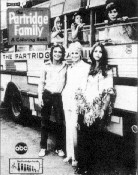
The money machine began when The Partridge Family premiered in 1970. Only a few products were released with a copyright of the same year. Just about the time a curious skunk climbed aboard the bus, forcing the family to bathe in tomato juice to remove the odor in episode #8, a coloring book and the first three paperbacks of a 17-edition set were issued. The coloring book features a color photo of the cast and tells the story of the first episode.
Avid fans scooped up the paperback books to read about daring adventures the Partridges never had on television. With titles like 'Thirteen at Killer Gorge" and "Marked for Terror," the books placed the group in dangerous positions with spies and jewel thieves. Coloring books are valued at about $25, while most of the paperbacks go for less than $ 10 each.
Also distributed before the year's end was the December release of their first record "The Partridge Family Album." What else would you expect to find in a family album but photos? A group photo was included in the album jacket, becoming the first of many premium inserts that would eventually accompany most later records.
It's interesting to note that all the records are marked with the caption "Starring Shirley Jones and featuring David Cassidy." They were the only cast members to lend their voices to the recordings. The rest of the cast appeared to be singing, but were merely lip synching. The first album can be found with the original photo insert for about $15.
By the time the bus pulled up to episode #16 in 1971, Partridgemania was in full swing. Laurie was picking up a song by The Rolling Stones on her braces, Keith was just about to get down with Richard Pryor in the "Soul Club," and Danny was soon to be convinced that he was adopted when Shirley couldn't find his birth certificate.
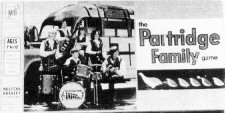 What collectors favor most about 1971 was that a flood of collectibles were released, including a Milton Bradley board game ($20-$25), comic books ($10-$15 each), three series of trading cards ($50-$75 each set), and a View-Master set
($20-$25). Three additional records hit store shelves and were selling at such a rapid rate, promoters wanted to book the Partridges for concert tours. Unfortunately, they had to be reminded group only existed on television.
What collectors favor most about 1971 was that a flood of collectibles were released, including a Milton Bradley board game ($20-$25), comic books ($10-$15 each), three series of trading cards ($50-$75 each set), and a View-Master set
($20-$25). Three additional records hit store shelves and were selling at such a rapid rate, promoters wanted to book the Partridges for concert tours. Unfortunately, they had to be reminded group only existed on television.
Fueling The Partridge Family money machine was Laufer Publications, famous for their Tiger Beat teen magazine. They introduced the first fan club, inducting an overwhelming 200,000 members in just one year. For a mere $2, each member was mailed a club kit that included a booklet of character profiles, stickers, black flexible record, membership card, wallet photos, and a mini-poster. Today a complete kit is valued at $75.
Also included in the kit was a secret decoder that enabled readers to read special messages that appeared in Tiger Beat's Official Partridge Family Magazine. Dedicated entirely to the show, the magazine was another success for Laufer, who claims to have sold over 400,000 copies a month during its initial run.
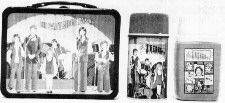 Lunch box collectors, as well as Partridge fans, seek out the metal box manufactured by King Seeley Thermos in 1971. The front of the box sports the family's colorful bus; the back features a distorted illustration of the family performing on stage. In the illustration, Laurie, played by Dey, stands next to her TV mom and appears to be about the same height as Danny. In actuality,
Susan is two inches taller than Shirley and towers over her TV brother.
Lunch box collectors, as well as Partridge fans, seek out the metal box manufactured by King Seeley Thermos in 1971. The front of the box sports the family's colorful bus; the back features a distorted illustration of the family performing on stage. In the illustration, Laurie, played by Dey, stands next to her TV mom and appears to be about the same height as Danny. In actuality,
Susan is two inches taller than Shirley and towers over her TV brother.
Released with a companion metal thermos bottle, and later reissued with a plastic bottle, the lunchbox is valued at $50-75. The metal and plastic bottles can be found for about $20 each.
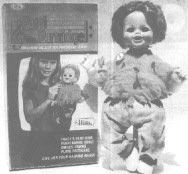 Probably the strangest of all the memorabilia released in 1971 was the Patti Partridge Doll by Ideal. Marketed as "Tracy's very own performing doll," it wasn't exactly Mrs. Beasley from Family Affair. With striking red hair and matching shawl, speechless Patti Partridge was more like a puppet, requiring the help of a hand to make her smile or move her arms.
Tracy did play with this doll in the television series, but it was rarely seen. In episode #40, "Home Is Where the Heart Is," Tracy can be seen holding Patti as she and Chris run away from home. Originally retailing for $12.95, collectors today can expect to pay more than $150 to add this boxed doll to their collection.
 In 1971, Saalfield and Artcraft printed a variety of Partridge paper products.
Together they manufactured three additional coloring books, a David Cassidy Paint and Color Album, and paper doll books and boxes. Traces of the original Chris, played by Jeremy Gelbwaks, can be seen on a handful of this merchandise. Paper collectibles copyrighted after 1971 feature the second Chris, Brian Forster. Unused coloring books are valued at $25 and paper dolls at about $40-$50 , David Cassidy's image was becoming increasingly popular during the show's following year, prompting his decision to break out of his TV persona and into the spotlight on his own. Much of the memorabilia produced during 1972 focused on his visage. Among them were David Cassidy comic books ($10-$15 each), jigsaw puzzle ($35-$45), paperback books ($5-$8), three ring binder ($20-$25), T-shirts ($30-40), clock face ($50-$75), beach towel ($40-$50) and Colorforms set ($25-$35).
In 1971, Saalfield and Artcraft printed a variety of Partridge paper products.
Together they manufactured three additional coloring books, a David Cassidy Paint and Color Album, and paper doll books and boxes. Traces of the original Chris, played by Jeremy Gelbwaks, can be seen on a handful of this merchandise. Paper collectibles copyrighted after 1971 feature the second Chris, Brian Forster. Unused coloring books are valued at $25 and paper dolls at about $40-$50 , David Cassidy's image was becoming increasingly popular during the show's following year, prompting his decision to break out of his TV persona and into the spotlight on his own. Much of the memorabilia produced during 1972 focused on his visage. Among them were David Cassidy comic books ($10-$15 each), jigsaw puzzle ($35-$45), paperback books ($5-$8), three ring binder ($20-$25), T-shirts ($30-40), clock face ($50-$75), beach towel ($40-$50) and Colorforms set ($25-$35).
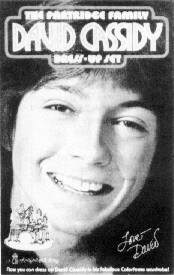 Cassidy also started his solo singing career in 1972, beginning with his premiere album "Cherish." The title track reached top 10 status, and thousands of swooning females flocked to stores to purchase the single in a picture sleeve, currently valued at $15.
Cassidy has continued to be a successful recording star, releasing more than a dozen albums well into the 1990s. He has also received praise for his recent work on Broadway, with his brother Shaun Cassidy, in Blood Brothers.
As The Partridge Family bus forged ahead during the remainder of the year, manufacturers continued to climb aboard and thrust the money machine into full throttle. Laufer Publications was printing enough teen magazines to stretch from Echo Valley to Albuquerque, offering fans the opportunity to buy exclusive merchandise from inside its pages.
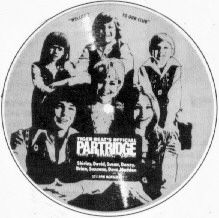 Still high on their enormous success with the fan club kits a year earlier, Laufer put together David Luvbeads, Luvcharms, Luv Stickers, posters, and booklets. Two additional fan club kits were offered as well. One was the All New Partridge Family Club Kit, featuring the second Chris, and the other was the David Cassidy Fan Club Kit. Each kit contained the usual paper paraphernalia, along with a private message record. The 1972 fan club kits record disc was far more attractive than that of the previous year. A family portrait silkscreen was printed on pink cardboard. David's kit included a similar record pressed onto blue cardboard. Complete kits are difficult to find, even at their $75 value.
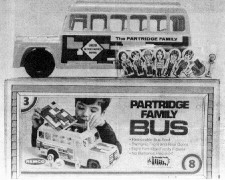 With the exception of a few records and magazines, 1973 was the last year original Partridge Family memorabilia was manufactured. This is not to say that the money machine had slowed down. This was the year, after all, that the most alluring item of all was made. The Partridge Family's multi-colored bus was molded into a plastic toy by Remco. Complete with figures of the entire family, guitar and drum, the bus has a removable roof, swinging front and rear doors, and comes with checkered, colored stickers. It was sold in a box that resembles a garage - perfect for storage and play. Truly the heart of the memorabilia collection, the bus is valued at about $500 in the original box. There are a few zealous collectors who are willing to pay a considerably higher amount to obtain this elusive piece, one most notably paying over $1,000 at auction.
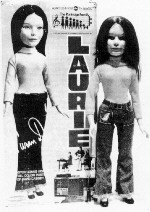 Some of the most valuable collectibles were released in the last year's run. They include the Laurie Partridge doll, lifesize David Cassidy jigsaw puzzle and two different David Cassidy toy guitars.
Wearing a hot pink sweater and tattered blue jeans, with a small Partridge on her hip pocket, the 19inch Laurie doll is an incredible likeness of Susan Dey. Manufactured by Remco, a complete box includes a bonus poster of Susan and David and is worth about $200.
Some of the most valuable collectibles were released in the last year's run. They include the Laurie Partridge doll, lifesize David Cassidy jigsaw puzzle and two different David Cassidy toy guitars.
Wearing a hot pink sweater and tattered blue jeans, with a small Partridge on her hip pocket, the 19inch Laurie doll is an incredible likeness of Susan Dey. Manufactured by Remco, a complete box includes a bonus poster of Susan and David and is worth about $200.
David Cassidy's charisma can be seen from the waist up on the cover of his lifesize jigsaw puzzle. Manufactured by APC, the puzzle is four feet tall, with each piece nearly six inches in diameter. A complete puzzle will run about $75.
Fans could simulate his rock star persona by playing one of two toy guitars made by Carnival Toys. The larger, 31-inch instrument has a red and white front with black trim. At first glance, it appears to be a real guitar, but it is molded from plastic.
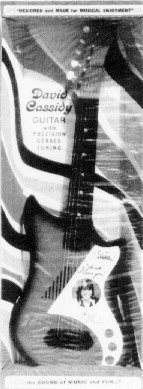 The 20-inch version is tan with a black handle. Both sizes feature the same photo of David, along with the inscription "Yours, David." The larger guitar includes the additional phrase "I Think I Love You." The 20-inch guitar can be found in the box for about $100, while the 31 inch boxed version may sell for $200.
The last season of The Partridge Family brought on a few changes that would prove to be fatal to the sitcom. Their comfortable Friday night time slot was moved to Saturday night, directly opposite from CBS's top-rated All in the Family.
Once a top 20 show, The Partridge Family took a nosedive in the ratings. ABC tried to resurrect it by breathing new life into the already established cast. A cute, bright four-year-old named Ricky Stevens, played by Ricky Segall, moved in next door. Little Ricky's musical numbers overshadowed the talents of Tracy and Chris as he became the spotlight in several episode endings. Deadly time slot aside, the addition of Ricky to the show was sure suicide for the Partridges. Just as the addition of Mrs. Brady's eight-year-old nephew, Oliver, signaled the end of The Brady Bunch, Ricky was a beacon that The Partridge Family bus took a wrong turn and was headed toward a dead end.
Nevertheless, Bell Records saw an opportunity and released a Ricky Segall album featuring his songs from the series. Danny Bonaduce wasn't far behind when he recorded is own selection of warbled tunes for Lion Records. Both albums spawned singles with picture sleeves. Collected strictly for their pop culture attributes, the albums and singles are worth $10-20 each.
As the popularity of collecting TV memorabilia escalates, it is getting more difficult to find items from classics like The Partridge Family. Considering how
the prices of these nostalgic treasures continue to rise, collectors can find yet another meaning to the term The Partridge Family money machine.
Bill Morgan and Greg Davis are authors of Collector's Guide to TV Memorabilia - 1960s and 1970s (Collector Books, 1996). It is available from the authors for $24.95 plus $3 at P.O. Box 11 002, Whittier, CA 90603-0002. Their email address is tvtoys@aol.com.
Explanation of Photos:
Several paper doll books of the Partridge Family were made. This one was published by Aricraft
The cream of Partridge collectibles - Remco's Partridge Family Bus (pictured is one from the Lisa Sutton collection) is a rare find, especially Mint in Box. It can sell for up to $500 in pristine condition.
The record that came with the 1972 fan club kit was printed on pink cardboard.
A 31-inch toy guitar made by Carnival Toys featured heartthrob David Cassidy's picture. It's valued around $200 MIB.
Cassidy was also highlighted on this Colorforms set, valued around $25-$35.
Wearing a hot pink sweater and tattered bluejeans, the 19-inch Laurie doll by Remco is an incredible likeness of Susan Dey. (Pictured is doll from the Lisa Sutton collection). Mint in Box, the doll is valued around $200.
King Seeley Thermos' 1971 steel lunch box provides a colorful image of the family. The middle metal bottle was issued with the box; later a plastic bottle was issued. The box is valued around $50-$75, and the books are valued around $20 each.
Patti Partridge by Ideal was a unique collectible, since the doll was rarely seen in the TV series. It's valued around $150 MIB today. (Doll from the Lisa Sutton collection).
Saalfield's coloring book featured a photo cover.
Milton Bradley's 1971 board game ($25.$35).
This set featured a Susan Dey paper doll in the fashions of Kate Greenaway.
Sidebars:
How do you Say 'Partridge' in Peru?
Shortly after The Partridge Family premiered on September 25, 1970, it could be watched around the world. Canada, Mexico, Brazil, Australia, Japan, and England were just a few of the countries airing the American show dubbed in their own languages. Worldwide popularity also generated a landslide of Partridge memorabilia. British annuals were produced by World Publishing Company for both The Partridge Family and David Cassidy. These hardcover books included illustrated stories, photos, word puzzles and other activities. Europe also saw the release of coloring books, jigsaw puzzles, and a small magazine called David Cassidy Monthly.
The Partridge Family and David Cassidy records were also released in several different countries. Each of them vary in packaging and design, and their photo sleeves make them a desirable addition to any American collection. The Topps American trading cards also went on a worldwide tour, making their appearance in Canada with an O-Pee-Chee label and in Australia under the name of Scanlens. Different trading card sets were manufactured in Holland by Monty Gum and in Italy by Top Sellers.
The Cosmic Partridge Family
When the series ended in 1974, The Partridge Family rose to a higher level...in outer space that is. Hanna-Barbera sent the family into orbit on September 7, 1974, for a total of 16 episodes in The Partridge Family: 2200 A.D. The family was featured in their cartoon counterparts, flying around in a multi-colored spacecraft. The only two who did not lend their voices to the toons were Shirley Jones and David Cassidy. Like the regular TV series, the cartoons were based on a quickly resolved mix-up followed by a catchy tune. The songs were recorded by an in-house staff at Hanna-Barbera studios and never made it to the record stores,
Unfortunately, the cartoon didn't produce any memorabilia. A few cartoon cells or original artwork from the short-lived series does pop up occasionally, however. Surprisingly, no episodes have turned up on Hanna-Barbera's run of cartoon classics on cable's Cartoon Network. If you want to have the 2200 A.D. experience, just watch The Jetsons. Lower the volume, put on your favorite Partridge record, and get happy.
 Back to the Collector's Corner